
Courtesy of The New York Times
Friday, Oct. 23rd, was my first introduction to Rose City’s pride and joy. The Portland Thorns FC regular season was coming to an end, and the club just managed to nudge their way into the playoffs. It was their clinch game — if they won this match at Providence Park, they would make it to the postseason. The crowd was animated, and a season pass holder insinuated to me that the audience’s energy was different today.
Four floors of stadium seats were filled; the crowd was pulsing — not one lurker hung in the forgotten back rows of the bleachers; every face was pressing to be closer to the field. Drums beat in a rhythm more fitting for a battlefield than a soccer match. The Rose City Riveters, the officially recognized supporters’ group of the Thorns, perched atop the lowest railing of the fan section where I sat and shouted chants in time with the war drums the entire game. An energy flowed through this crowd that needed to be expressed.
Toward the latter half of the match, my view of the field and focus on the players were broken by a gaggle of black tees holding up signs: “Save Women’s Sports.” My positive reflections on this group’s message were suddenly called into question when I heard an audience member shout a long list of obscenities in the group’s direction. “Bigot” and “insecure” are some of the only words I feel comfortable quoting.
I saw the source of the audience’s anger written across a protester’s chest in simple lime green text: XX-XY — a clothing brand that says it protects women’s sports and that critics say is anti-trans.
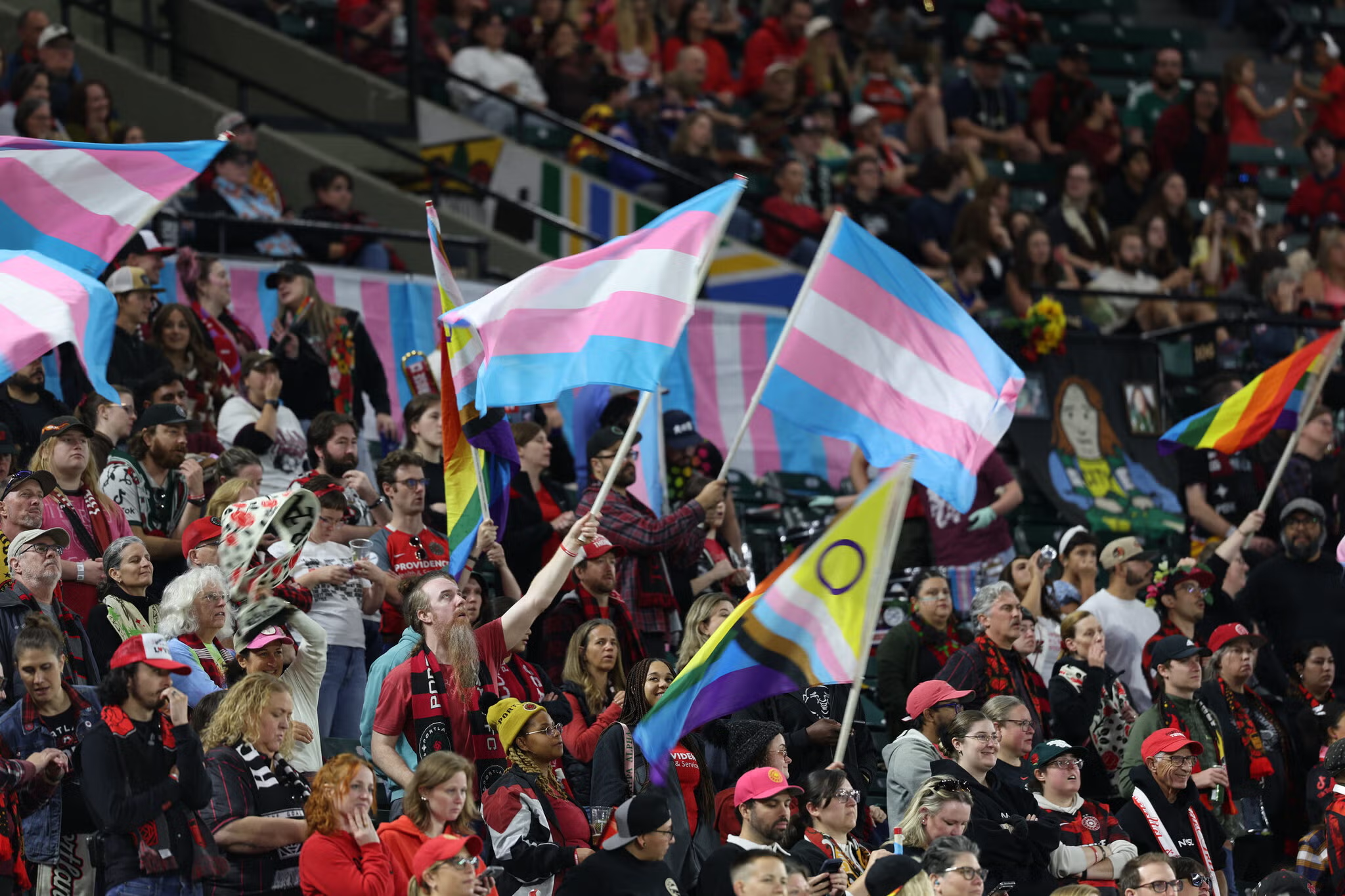
The audience was furious, yet from where I sat, I did not see violence. Portland kept its cool and expressed its distaste through a peaceful counter-protest. The Riveters shuffled pride flags through the bleachers and rolled down a long white canvas. The attention had shifted away from the Thorns, and the chants had become a rallying cry: “Trans Lives Matter.”
I saw a smug grin spread across the face of one of the XX-XY protesters, whom I later figured out was Brandi Kruse, a political commentator and podcast host. The image of her being escorted by three security guards is imprinted in my mind — she looked satisfied. It was striking because it forced my perspective into her shoes.
I thought, “If I were her, why would I be happy right now?”
Attention.
She was relishing it — recording the angry faces that shouted at her all the while, maintaining that innocent grin public personas adopt. Kruse wanted this on camera — she was trying to create a narrative and appeal to an audience.
“People are saying, ‘Oh, this was staged, this was staged’ — well, of course it was,” said Brandi Kruse in a statement to the New York Times.
It was a planned advertisement, not a protest. XX-XY was riding the conservative wave rippling through Western society. This protest had no meaning besides self-interest and this was not the first time they had pulled a stunt like this. At a WNBA game, XX-XY had hosted a similar protest and immediately after saw their biggest month in sales yet. The scene at the Thorns game felt fake firsthand, and learning that this was a tactic in XX-XY’s playbook afterwards cemented the thought that this protest was sensationalism.
The modern world, changed by the rise of social media, has given way to a litany of issues regarding censorship while simultaneously providing millions with a platform that is seen across the globe. I believe that people have the right to express themselves freely, but said expression must be held to a standard. A protest should inspire change, be peaceful and draw attention to the cause rather than the protester. This is not what I saw happen at the Thorns match.
It was my first visit to Providence Park, and I hoped that this match would give me a break from the internet’s own sensationalism. I wanted to turn my attention to humans doing a human thing: Competition. That is human nature and expression, not an ASMR video created by a faceless LLM, not a two-faced politician lying at the podium nor is it an adultery scandal surrounding H3H3’s Ethan Klein — all three scenarios might be entertaining to follow, but they do not have much substance when compared to the fanfare at a live sports game. Many influencers online sensationalize their content, only caring about engagement, not the message. This engagement fuels their sponsorships, turning the majority of content into long-form advertising.
To paraphrase John Milton, chronicler of the fall of humanity and a fierce academic in support of free speech: we do not have the right to stop people from publishing bad books, but we most certainly have the right to burn said books after publication.
I do not have an issue with any opinions that are different from mine, but once their expression becomes a nuisance and the expressor seems motivated by selfishness, I will not stand and support absolute freedom of expression.
Brandi Kruse might retort that I am describing an echo chamber; that calling for the removal of a protest or an unpopular opinion is an abuse of free speech.
To that I say, to hell with freedom. I came away believing these people do not care about their cause or their message. They want to profit off of violent reactions, prove Trump right and show the world that life in Portland really is “like living in hell.” We did not give them that satisfaction. The Riveters maintained order and shamed the sensationalism to the point of removal. The protest was drawing attention away from the sport they were supposedly trying to save and instead toward themselves — to me, that is an abuse of free speech.
About the Author


